|
Patrick Riley
Rex ... your link to 31 old time photos was one of the most fun and educational things I've looked at in a long time! I urge all classmates who haven't clicked this link to do so. Looking at these reminds me of one of my favorite sayings: "The good old days sucked!"
My favorite photo is #21: This women's basketball team".
Another photo deserves comment ... #61: This man showing his grandson his machine gun. This is actually a fairly well known historic photo.
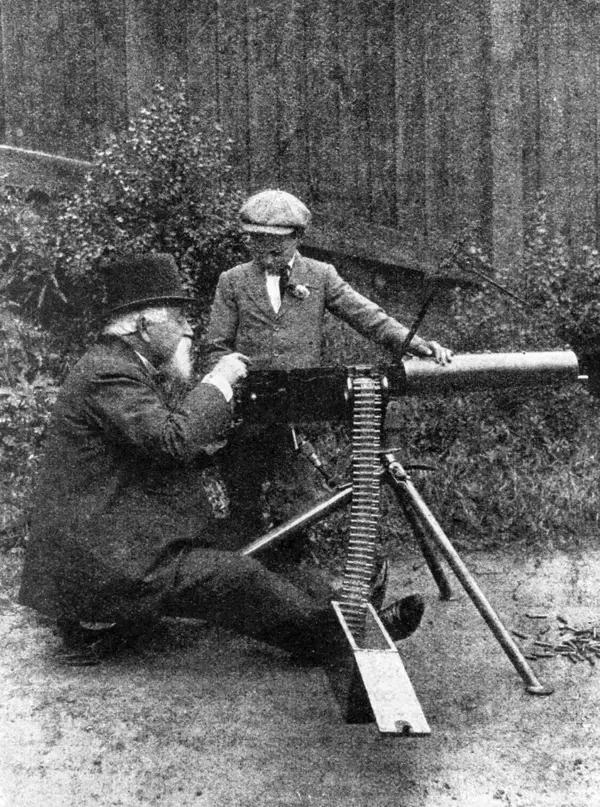
"This man" is actually Hiram Maxim ... he invented what became a world changing weapon, the Maxim Machine Gun. His story get quickly intertwined with the most famous firearms designer of all time, John Moses Browning. I could go on forever about this man's accomplishments but let me stick to this story.
Both trace to American inventors, and between them they defined machine-gun design for the better part of a century.
The Maxim Gun
Hiram Maxim, an American-born inventor working in London, patented the first true automatic machine gun in 1884. His breakthrough was using the gun's own recoil to eject the spent case, chamber a fresh round, and fire again for as long as the trigger was held. Earlier guns like the Gatling required hand-cranking. His prototype fired about 600 rounds per minute from a cloth belt, and a water jacket around the barrel kept it from overheating during sustained fire.
The British Army adopted it in 1889, and its colonial debut was brutal: at the Battle of Omdurman in 1898, Maxims helped kill roughly 10,000 Mahdist soldiers for a few dozen British losses. Maxim's company merged with Vickers, and the refined Vickers gun (1912) became the standard British heavy machine gun through both world wars, famous for reliability; one Vickers reportedly fired nearly a million rounds over 12 hours at the World War I battle of the Somme. Germany licensed the design as the MG 08, and Russia also licensed it as the PM 1910, so during this war, both sides were essentially shooting Maxims at each other. The gun is often blamed for the trench stalemate of World War I, since a handful of crews could stop an infantry assault cold. The Russian PM 1910 stayed in service through World War II and was still turning up in Ukraine after 2014.
The Browning Guns
John Moses Browning of Ogden, Utah, took a different path. In 1889 he noticed muzzle blast rustling reeds at a shooting range and built a gas-operated gun that tapped propellant gas from the barrel to work the action. Colt produced it as the M1895, nicknamed the "potato digger" because its swinging lever would dig into the dirt if mounted too low. It saw action with the Marines in Cuba in 1898 and in China during the Boxer Rebellion.
Browning then turned to recoil operation, but with a lighter short-recoil mechanism than Maxim's. He patented it in 1901 and finally demonstrated it to the Army in 1917 as the U.S. entered World War I. The water-cooled M1917 was adopted almost immediately, followed by the air-cooled M1919, which became the standard American medium machine gun of World War II, Korea, and Vietnam, mounted on tanks, jeeps, aircraft, and tripods. He also designed the Browning Automatic Rifle (BAR), the forerunner of all modern assault rifles, in the same period.
When General Pershing asked for a heavier weapon to defeat armor and aircraft, Browning scaled up the M1917 to fire a new .50-caliber cartridge in 1918. That evolved into the M2 "Ma Deuce," standardized in 1933. Roughly two million were built for World War II, arming everything from B-17 turrets to Sherman tanks to infantry tripods. It is still the U.S. military's standard heavy machine gun today, over 90 years after adoption, and Browning's basic design, drawn up before he died in 1926, has needed only minor updates such as a quick-change barrel.
The Connection
Maxim proved automatic fire was possible and shaped how the first machine-gun war was fought. Browning simplified and improved the mechanism, and his guns outlasted every Maxim derivative; the Browning designed M2 is arguably the longest-serving firearm design in history. A close runner up would be the Browning designed Colt Model 1911 .45-caliber semi-automatic pistol general called the "Colt 45" to this day.
The Back Story
In my duck hunting days in high school, one of my prized possessions was a Browning 3-inch magnum automatic shotgun gifted to me by my father. It was a beautifully designed work of functional art manufactured in Belgium.
By the way, many of us (myself, Don Hayes, John Denton, Tom Mangham, John Burkstaller, and Howard Holt ... among others) brought our shotguns to school (in the truck of the car) from dove season starting in September, through quail season, and on into waterfowl season ending in February (maybe). On other occasions, we'd bring our 22s with us for rabbit hunting. No one thought anything about this and I even remember taking a teacher, Mr. Berckes, out to the parking lot to look at my shotgun. I shouldn't admit this but, on a few occations, I took my (Browning designed and above mentioned) Colt 45 into school to show it off. I'd leave it in my locker thinking I probably shouldn't take it from class to class. I'm not sure if there was any rules against this at the time (and never asked in case there were) but boy ... how times have changed!
|





 ~ The Shadow